Governance
BioGeoSCAPES began as a volunteer-led effort to connect researchers studying ocean metabolisms. Support from the U.S. National Science Foundation’s AccelNet program enabled the development of the international network of networks needed to launch the program.
A SCOR-endorsed major program
In 2026, BioGeoSCAPES was formally endorsed as a major program of the Scientific Committee on Oceanic Research (SCOR), marking its transition from international planning to coordinated implementation guided by the community-developed Science Plan.
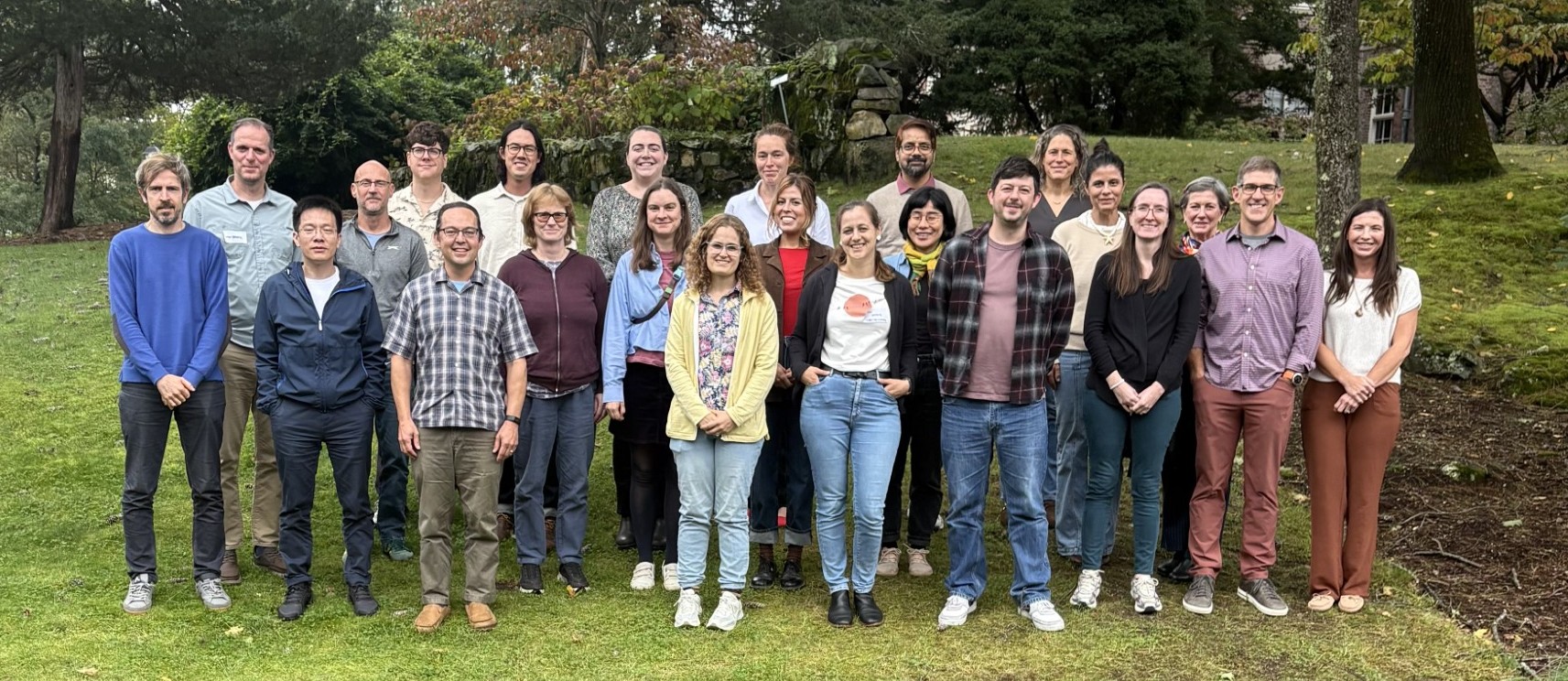
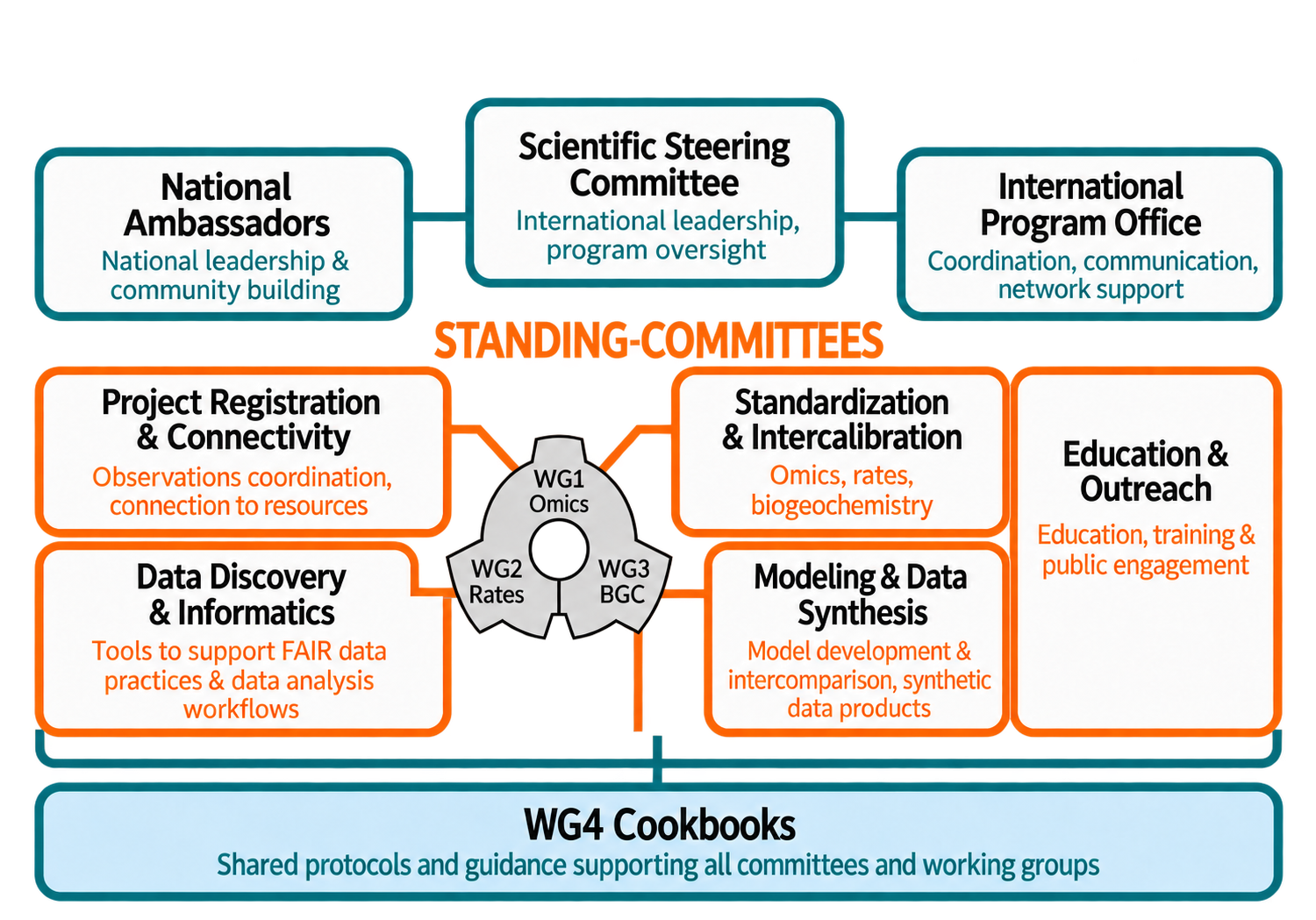
With this transition, the International Implementation Committee became the Scientific Steering Committee (SSC) (pictured right at MIT Endicott House in September 2026). The program’s governance and coordination structure brings together the SSC, International Program Office, National Ambassadors, five standing committees, and four working groups.
Scientific Steering Committee (SSC)
The SSC provides international scientific leadership and program oversight. It guides implementation of the Science Plan, establishes priorities, and coordinates the work of the standing committees and working groups.
International Program Office (IPO)
The IPO supports day-to-day program coordination, communications, and community engagement. It connects leadership, committees, working groups, and the broader community to help turn shared priorities into coordinated activities.
National Ambassadors
National Ambassadors connect BioGeoSCAPES with research communities in their countries. They share program information and opportunities, encourage participation, and bring national and regional perspectives into the international program.
Meet the National Ambassadors →
Standing Committees
Five standing committees support the program’s ongoing implementation. Their work connects scientific priorities with the tools, practices, and partnerships needed for international collaboration.
Registration & Connectivity
Develops project registration and community networking tools to connect researchers, studies, resources, and opportunities for collaboration.
Data Discovery & Informatics
Advances data discovery, access, and interoperability through shared metadata frameworks and approaches that support integration across disciplines.
Standards & Intercalibration
Supports consistent, comparable measurements through intercalibration, shared standards, and best practices across omics, rates, and biogeochemistry.
Modeling & Data Synthesis
Connects observations and experiments with models to advance data synthesis and predictive understanding of ocean metabolisms.
Education & Outreach
Supports training, capacity development, communications, and public engagement to broaden participation and share the program’s science.
Working Groups
Working groups address specific implementation tasks and evolve as program priorities develop. Four initial groups bring complementary expertise to the development of metadata templates, methods, and practical guidance.
WG1: Omics
Focuses on molecular measurements and approaches for characterizing marine microbes and their metabolic capabilities.
WG2: Rates
Focuses on measurements of microbial processes and the rates at which they influence ocean biogeochemical cycles.
WG3: Biogeochemistry
Focuses on chemical measurements and environmental context needed to connect microbial metabolisms with nutrient cycles.
WG4: Cookbooks
Develops shared protocols and practical guidance in collaboration with the other working groups and standing committees, supporting consistent methods and interoperable measurements.
Get involved in program leadership
We welcome self-nominations and nominations of others for seats on BioGeoSCAPES Standing Committees and Working Groups. Nominees will be added to a pool for consideration as positions become available, including current openings. Names will remain in the pool for one year from the date of submission.
Selection considers relevant expertise and balanced representation across disciplines, geographic regions, and career stages.