What is BioGeoSCAPES?
Earth’s life support system is underpinned by microbial biogeochemical cycles, where essential elements are transformed and recycled within the environment. Despite over a century observing Earth’s biogeochemical cycles, we still lack fundamental knowledge about the environmental and microbial controls on these essential biogeochemical cycles. This knowledge is necessary for understanding the response of the Earth system to human perturbations.
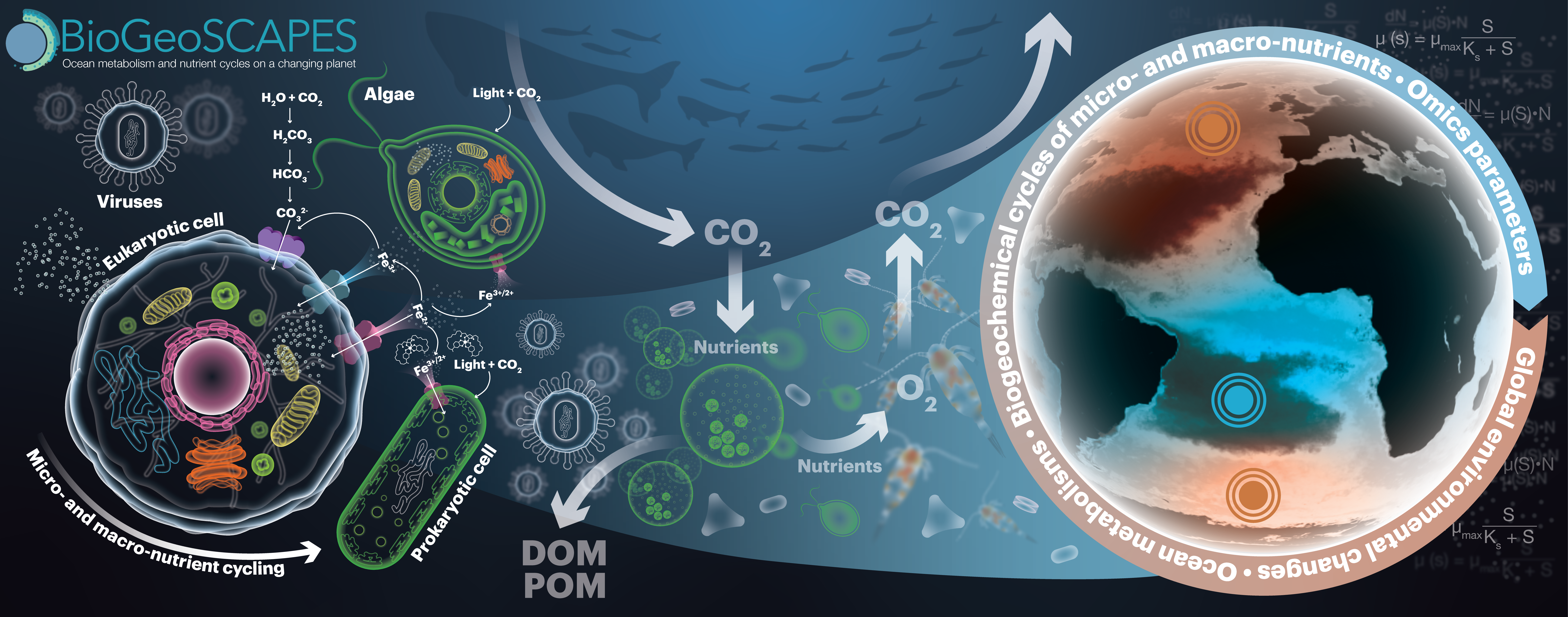
An international community effort has been underway to create a global-scale research program called BioGeoSCAPES by the mid-2020’s to improve our understanding of the microbial biogeochemistry of the oceans. The BioGeoSCAPES program will involve multiple scales of study, from regional processes to ocean basin-scale, and combine the capabilities of new omic and micronutrient techniques to provide a comprehensive understanding of biogeochemical dynamics and connect them with a numerical pipeline that integrates computational biology and ocean biogeochemical modeling. BioGeoSCAPES will be underpinned by robust interoperable data standards and intercalibration efforts to create an international interoperable data system that nations around the world can contribute to and participate in. BioGeoSCAPES would create the first global scale microbial maps revealing the distribution of microbes and their genes in every ocean basin, mapped at the same density we can map macro and micronutrient distributions. From resultant global ocean datasets, BioGeoSCAPES would enable a new generation of ocean ecosystem modeling that integrates omics data and transforms our understanding of how the oceans operate.
What is AccelNet BioGeoSCAPES?
To enable the launch of BioGeoSCAPES, an Acceleration of Networks (“AccelNet”) grant from the US National Science Foundation was obtained that will support international activities. AccelNet is a program that focuses on the development of international collaboration. AccelNet does not fund scientific research activities directly, instead it offers support to build the “networks of networks” needed for international collaboration through workshops and educational exchanges.
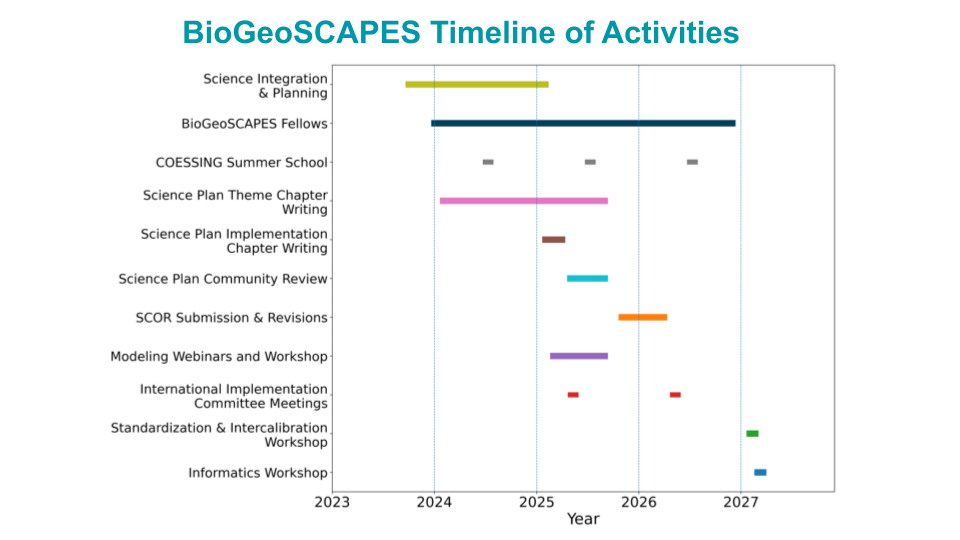
This AccelNet project will build the network-of-networks required to develop foundational scientific and infrastructural components of BioGeoSCAPES through community activities, including workshops and working groups focused on 1) the development of a detailed, globally-supported science plan; 2) the identification of key scientific interests and expedition goals with international thematic meetings; 3) the development of intercalibration and standardized best practices and data integration and management plans that combine international efforts into cohesive interoperable global data products; 4) the integration of modeling efforts across a range of scales; and 5) the identification and development of logistical and infrastructure needs to support such an effort. There will be a particular focus on early career scientist exchanges to facilitate both the development of a new generation of interdisciplinary scientists and enable key technical exchanges internationally. Finally, we will develop and implement the program governance through the formation of an international Science Steering Committee and subcommittees, building on the model used by other international-scale marine science programs such as GEOTRACES, IMBeR and SOLAS. These committees will prioritize broad and equitable engagement with the diverse constituencies, which will be essential to successfully launch BioGeoSCAPES. These efforts will foster the development of the BioGeoSCAPES program in coordination with the efforts of international colleagues, with the goal of establishing leadership, science plans, infrastructure, data management capabilities, and national funding resources in place by the end of the grant, enabling progression towards the launch of a BioGeoSCAPES program by the mid-2020’s.
BioGeoSCAPES is supported by Ambassadors representing 27 nations. In preparation for the first BioGeoSCAPES International Science Planning meeting in the Fall of 2023, we asked nations to organize BioGeoSCAPES national planning workshops to inform the international organizing committee of how each nation could become involved in and be supported by a BioGeoSCAPES program. Reports from these national meetings were used to develop the themes of the Science Plan, which was collaboratively outlined during the 2023 International Science Plan Meeting. Writing groups have been formed for each of the main Science Plan chapters, which will be collaboratively written by a group of volunteer champions of BioGeoSCAPES beginning in February 2024.
The BioGeoSCAPES Science Plan
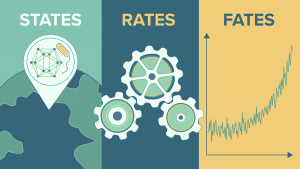
The Science Plan will focus on three main themes:
STATES: mapping key ocean metabolisms over space and time to generate 4-D maps of the abundances of key microbes and microbial biogeochemical processes and their drivers
RATES: mechanisms connecting microbial metabolisms and productivity to biogeochemical cycles to build a conceptual framework for the links between microbial ecology and biogeochemical cycles
FATES: predicting interactions with environmental factors to provide risk and vulnerability assessments for key ocean metabolisms on a changing planet
Additional sections will address implementation strategies and opportunities for partnership with existing programs.
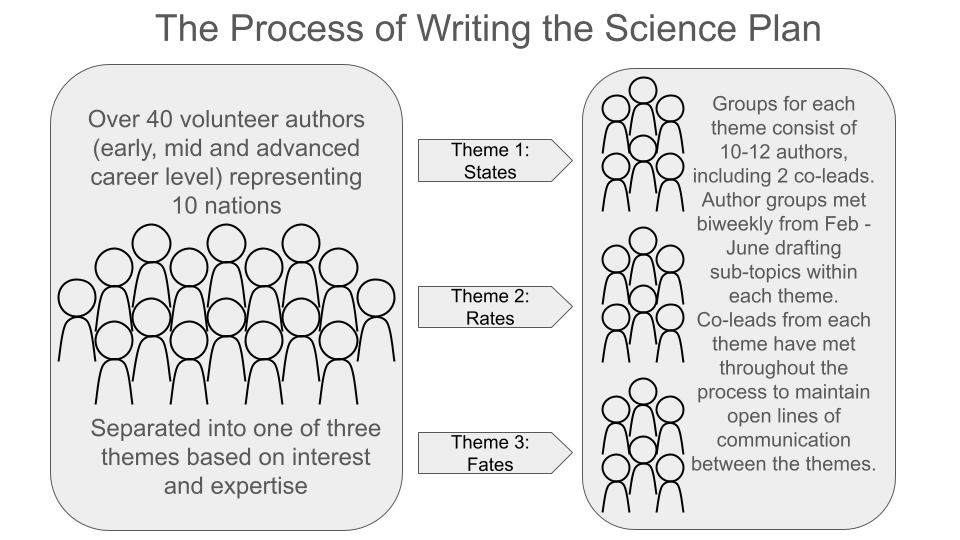
The BioGeoSCAPES Science Plan has been refined through multiple rounds of internal review and is now under review and consideration by the Scientific Committee on Oceanic Research (SCOR) for potential endorsement. We’re excited to share the final plan in early 2026. Subscribe to our mailing list to be the first to know when it’s released!
Working Groups and Community Initiatives
To achieve its mission of understanding the connections between marine microbial metabolisms and global biogeochemical cycles, BioGeoSCAPES organizes its research efforts through several interdisciplinary Working Groups. These groups bring together scientists across disciplines, career stages, and geographic regions to collaboratively develop tools, standards, and approaches for studying marine ecosystems.
Modeling Working Group
The Modeling Working Group focuses on developing and integrating computational and theoretical approaches that capture metabolic and biogeochemical interactions across multiple scales. This group explores diverse model types, from cellular to regional and global-scale models, focusing on the parameters, outputs, and scales necessary to link microbial metabolic activity to marine biogeochemical cycles. Click here to learn more.
Standardization and Intercalibration Working Group
This group addresses the the need for universally accepted practices for the collection, preservation, and processing of marine 'omics samples, including metagenomics, metatranscriptomics, metaproteomics, metabarcoding, and eDNA. By coordinating intercomparison and intercalibration studies across laboratories and research cruises, this group aims to quantify variability, identify best practices, and establish robust methods that ensure the comparability and reproducibility of BioGeoSCAPES datasets worldwide. Click here to learn more.
Data Management and Informatics Working Group
Recognizing the critical role of data in integrative ocean science, this group develops strategies for data storage, curation, accessibility, and visualization. Efforts include designing interoperable databases, standardized metadata formats, and user-friendly interfaces, enabling efficient sharing of large-scale microbial, chemical, and environmental datasets across the BioGeoSCAPES community. Click here to learn more.
BioGeoSCAPES Cookbooks
A central goal of BioGeoSCAPES is to provide practical, community-driven resources for marine microbial and biogeochemical research. The BioGeoSCAPES Cookbooks are being developed to compile validated protocols for sampling, sample processing, and analytical techniques. These living documents will support rigorous and reproducible science and serve as an accessible reference for both established researchers and new entrants to the field. Click here to learn more.
Early Career Fellows Program
The BioGeoSCAPES Early Career Fellows are scientists within 10 years of receiving their PhDs, representing diverse research expertise and geographic backgrounds. Fellows actively contribute to advancing BioGeoSCAPES science initiatives while also taking on leadership roles in BioGeoSCAPES Working Groups and in the development of the Science Plan, the Cookbooks, educations modules and other research products. This program provides a platform for emerging scientists to influence the direction of the BioGeoSCAPES, build interdisciplinary collaborations, and gain experience in shaping large-scale oceanographic research efforts. Click here to learn more.
Bottom-Up Community Building
BioGeoSCAPES is designed as a bottom-up initiative that encourages broad participation from individuals and lab groups across the globe who are interested in understanding the links between marine microbial metabolisms and biogeochemical cycles. Through inclusive engagement in Working Groups, collaborative projects, ongoing networking and educations activities, and shared resources such as the BioGeoSCAPES Cookbooks, the program fosters a vibrant, participatory scientific community where contributions from a wide range of perspectives help guide research priorities and outputs.
How Can I Get Involved?
Over the next four years, the BioGeoSCAPES Accelnet will host virtual and in-person activities to prioritize and plan foundational components of a collaborative international BioGeoSCAPES initiative, including Modeling & Data Integration, Standardization & Intercalibration, and Informatics & Data Management. These activities may include webinar series, topical workshops, and smaller group planning meetings. We are seeking YOUR collaboration and leadership to help plan these activities. The Accelnet will also include numerous education/capacity building & professional development activities. Please click here if you wish to be involved in a particular aspect of the Accelnet.